Funnel.io vs. Supermetrics vs. Weavely: Which Data Pipeline Fits Scaling Agencies?
There is a specific threshold every scaling agency hits where manual reporting workflows stop being a minor nuisance and start becoming a distinct liability to growth.
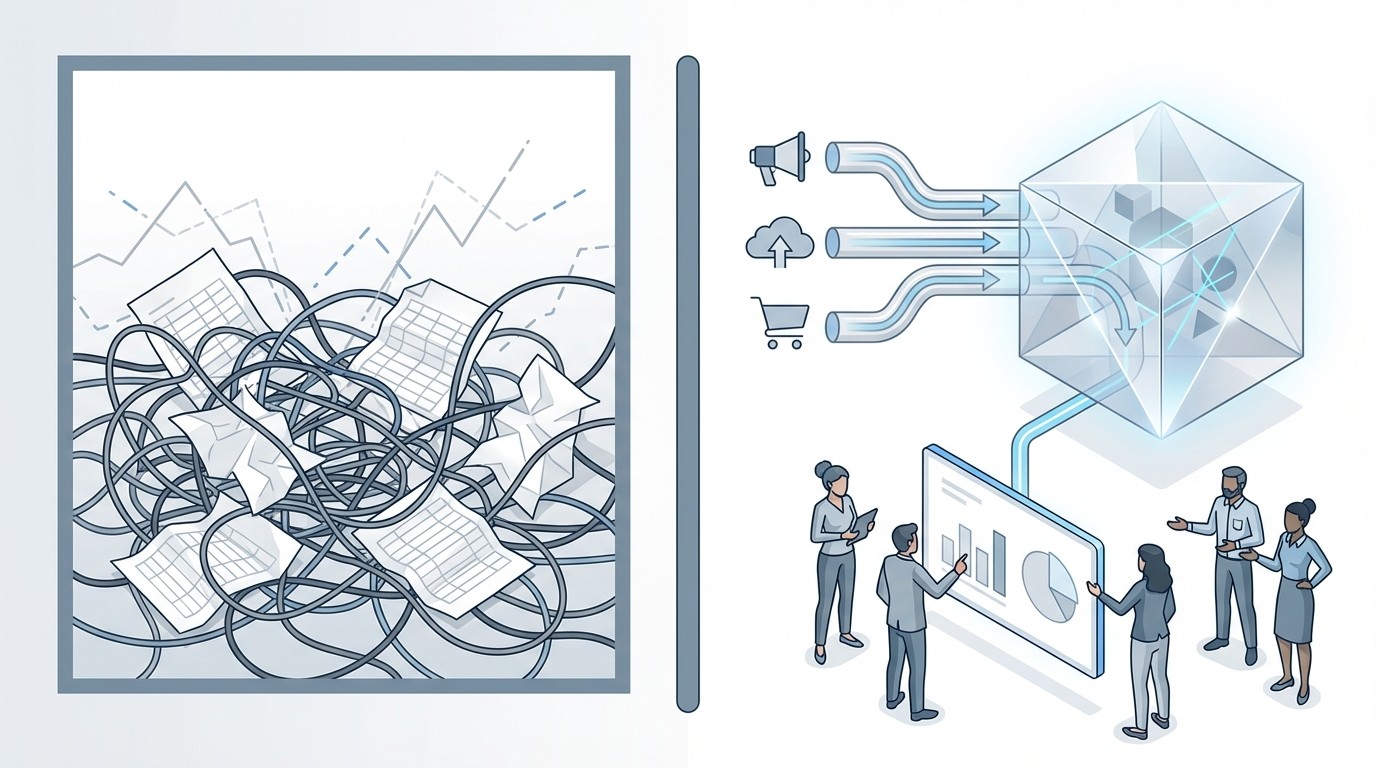
Most scaling agencies hit a point where manual reporting stops being annoying and starts actively slowing growth.
If you’re here, your team is probably spending too much time babysitting connectors, fixing broken pulls, and reconciling mismatched fields, and not enough time actually using the data. The setup that worked when you had a handful of clients (direct connectors, CSV exports, a few key spreadsheets) usually buckles once client volume and channel complexity increase.
When teams start researching a more durable setup, the conversation typically becomes funnel io vs supermetrics. Both are well-known tools and both solve the immediate problem of aggregating marketing data. But if you treat this as a feature checklist, you can miss the bigger decision: are you optimizing for fast reporting, or for long-term data ownership?
This article breaks down the structural differences between the platforms. We’ll compare the connector-based approaches of Funnel.io and Supermetrics with Weavely’s warehouse-native model, so you can decide whether you need a short-term reporting fix or a foundation you can scale on.

At a Glance: Funnel.io vs. Supermetrics vs. Weavely
If you want the architectural differences upfront, here’s the short version.
Traditionally, agencies compared Funnel.io’s managed transformation layer with Supermetrics’ direct connectors. Weavely adds a third option: a warehouse-native pipeline.
Feature | Funnel.io | Supermetrics | Weavely |
|---|---|---|---|
Best for | Mid-sized agencies needing automated, harmonized reporting without technical setup. | Small teams or ad-hoc analysis in Google Sheets and Looker Studio. | Scaling agencies building a central data asset and requiring full data ownership. |
Core architecture | Proprietary ETL (Extract, Transform, Load) to internal storage. | Connector/data mover (extracts to destination directly). | Warehouse-native ELT (extracts and loads to your warehouse). |
Data destination | Funnel’s proprietary storage and exports to BI tools. | Google Sheets, Looker Studio, Excel, BigQuery (via add-on). | Your BigQuery data warehouse |
Data ownership | Vendor-controlled. Data sits inside Funnel until you export it. | Fragmented. Data ends up in spreadsheets or third-party reporting layers. | Agency-controlled. You retain raw data in your warehouse. |
Pricing model | Flex/spend-based (scales with ad spend and connectors). | Per user, per connector, per data source. | Usage-based, warehouse-centric scaling. |
Key limitation at scale | Lock-in risk; cost increases with volume; limited cross-domain joins. | Spreadsheet performance and governance issues once you scale. | Requires a cloud data warehouse (Weavely automates the pipeline, but you still need the warehouse). |
See the warehouse-native difference. Take a 2-min interactive tour of Weavely to see how owning your data changes the workflow.
The Core Difference: Data Connectors vs. a True Data Warehouse Pipeline
To make a good call, ignore the UI for a minute and look at what’s happening under the hood. This is an infrastructure decision more than a dashboard decision.
Model 1: The Connector and Aggregator (Funnel.io and Supermetrics)
Funnel.io and Supermetrics both focus on getting data into a format that’s easy to report on quickly.
Supermetrics is primarily a pipe. It pulls data from platforms like Meta or LinkedIn and pushes it into a destination like Google Sheets. It’s not designed to manage long-term history or complex state; it’s designed to move data.
Funnel.io adds an internal storage and transformation layer. Data is pulled in, stored in Funnel’s environment, cleaned or mapped there, and then pushed into a BI tool.
Think of this model like renting a furnished apartment. It’s convenient and quick to get started, but your ability to remodel is limited. If you stop paying rent, you don’t keep the place.
Model 2: The Warehouse-Native Pipeline (Weavely)
Weavely follows a warehouse-native ELT model. It extracts raw data from APIs and loads it directly into a cloud data warehouse you control, such as BigQuery, Snowflake, or Redshift. Transformations happen in the warehouse rather than inside a proprietary transformation layer.
This is closer to building on land you own. You keep the foundation (the warehouse), and you can change tools later without losing your historical dataset.
For a scaling agency, that difference matters. With the connector-and-aggregator model, your reporting might improve, but your data asset usually doesn’t. With a warehouse-native pipeline, you’re building a long-term system you can extend.
Deep Dive: Funnel.io: The Managed Reporting Layer
Funnel.io has earned its position by making messy marketing data easier to work with. It’s often used as a hub between ad platforms and visualization tools.
Strengths
Funnel.io’s biggest advantage is usability. Non-technical teams can map and normalize fields across sources, for example aligning Facebook Campaign Name and Google Ads Campaign into a unified campaign dimension without writing SQL.
It’s a strong fit for agencies that need cross-channel dashboards quickly and don’t have data engineering resources. Funnel manages connector maintenance and provides cleaner output to tools like Looker Studio or Tableau.
Limitations for Scale
The convenience has tradeoffs, especially once your agency wants deeper ownership.
The proprietary storage layer: Your historical data lives inside Funnel’s ecosystem. If you leave, you can export data, but you lose the continuously maintained environment that kept that history up to date.
Pricing predictability: Pricing is often tied to spend or usage constructs such as flex points. As clients scale spend or you add sources, cost can rise quickly.
Harder cross-domain analytics: Funnel is strong with marketing data, but agencies often want to combine spend and performance with CRM revenue, pipeline stages, or internal billing. Those joins are harder when your data hub isn’t built as a general-purpose warehouse.
Deep Dive: Supermetrics: The Spreadsheet Power-Up
Supermetrics is one of the most common ways marketers pull data, especially in Google Sheets and Looker Studio.
Strengths
It’s excellent for quick analysis. The connector library is broad, including many long-tail platforms. Setup is minimal and the workflow is familiar for most performance teams.
For tactical questions, such as sanity-checking CPA week over week or pulling a slice of campaign data to validate an idea, Supermetrics is hard to beat.
Limitations for Scale
When you try to use Supermetrics as the backbone of an agency-wide reporting system, the weaknesses show up.
Spreadsheet sprawl: As you add clients, you end up with a growing pile of Sheets feeding dashboards. Links break, credentials expire, and maintenance becomes its own job.
Performance limits: Spreadsheets aren’t databases. Pull enough history or enough granularity and you’ll hit timeouts, row limits, or slow performance. Teams then start trimming history, which reduces analytical value.
Governance gaps: Supermetrics is often purchased and managed per user. Over time that can create security, access, and cost control issues across the agency.
In practice, Supermetrics is a data mover. It gets data where you need it, but it doesn’t create a durable data layer.
Deep Dive: Weavely: The Modern Data Stack for Agencies
Weavely is built around the modern data stack approach. The assumption is simple: if your agency depends on data, that data should live in an environment you control.
Strengths
Weavely loads marketing data from platforms like Meta, Google, TikTok, and LinkedIn into a warehouse your agency owns.
True ownership: You own the warehouse project, the tables, and the history. If you stop using Weavely, the data remains in your warehouse.
Built for scale: Cloud warehouses are designed for large volumes and long history. You’re not fighting spreadsheet limits or relying on a vendor’s storage constraints.
BI flexibility: Once data is centralized in your warehouse, you can use Looker Studio, Tableau, Power BI, or custom scripts against the same dataset.
Solving the Scaling Problem
If your team has outgrown Funnel.io or Supermetrics, the typical gap is reliability plus ownership. Weavely focuses on getting raw data into your warehouse consistently, even as APIs change and schemas evolve.
That shifts your team’s time toward higher-value work: modeling, cross-client benchmarking, and more advanced analytics. Those are difficult to do when your data is split across spreadsheets or locked inside a proprietary layer.
Decision Framework: Which Pipeline Should Your Agency Choose?
The question isn’t which product is best in general. It’s which approach matches your agency’s current maturity and where you want to end up.
Choose Funnel.io if:
You need centralized reporting quickly and you don’t have SQL or data engineering support.
You’re comfortable with a vendor-managed storage and transformation layer.
Your priority is visual reporting rather than long-term raw data ownership.
Choose Supermetrics if:
Your team is committed to Google Sheets and prefers that workflow.
You mainly need tactical pulls for ad-hoc analysis, not a full historical pipeline.
You’re a freelancer or boutique agency with low complexity and modest data volume.
Choose Weavely if:
You treat data as an asset and want a historical database your agency controls.
You want flexibility to change BI tools and combine marketing data with CRM or finance data later.
You’ve hit the limits of spreadsheets and need the scalability, security, and speed of a warehouse like BigQuery or Snowflake.
Final Verdict
The funnel io vs supermetrics debate is useful when you’re trying to relieve immediate reporting pain.
Supermetrics is strong for fast, spreadsheet-based analysis.
Funnel.io is strong when you want a managed layer for harmonized marketing reporting.
But if your agency is optimizing for long-term operational maturity, the warehouse-native approach is the cleanest path to data sovereignty. With Weavely, raw data lands in your own cloud warehouse, stays there, and remains usable regardless of which BI tool or pipeline vendor you use in the future.
Ready to scale without reporting stress?
Join agencies who have eliminated manual reporting and built a data infrastructure they can actually trust

Own your marketing data. Scale without limits.